By Uko Etim
Stakeholders from Ministries of Health, Education, Justice and Women Affairs in Akwa Ibom have pledged their commitment to the Safe Termination of Pregnancy (STOP) guidelines to help reduce high rates of maternal mortality in the state.
STOP guidelines are set of medical protocols that guide healthcare professionals on safe and legal abortion in Nigeria.
Akwa Ibom, which is one of the six states in Nigeria to adopt and domesticate the STOP guidelines, ranks highest in maternal mortality rate in the country.
Despite this, it was revealed that many women and health workers in the state are still not aware of the guidelines.
Dr. Matthias Abah, State Coordinator of the Society of Gynaecologists and Obstetricians of Nigeria (SOGON), Akwa Ibom chapter, said the STOP guidelines align with international best practices and offer legal support for the termination of pregnancies that pose a risk to the mother’s health.
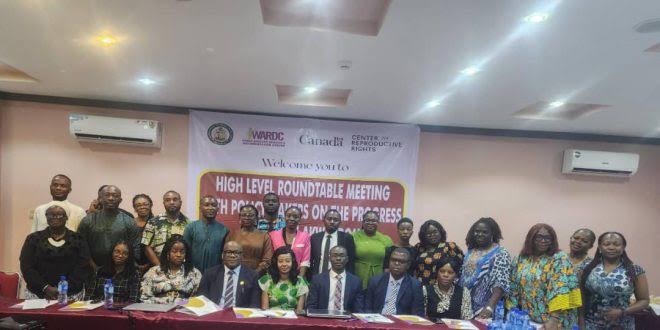
He made this known while speaking at a High-Level Roundtable Meeting with policymakers on the progress of Sexual Reproductive Health Rights (SRHR) in Uyo on Thursday.
The meeting was organised by the Women Advocate Research & Documentation Centre (WARDC) in partnership with the Ministry of Women Affairs with support from Centre for Reproductive Rights and sponsored by Global Affairs Canada.
Abah lamented the low awareness of the guidelines among healthcare workers, but noted that SOGON is working closely with the Ministry of Health to enhance dissemination and publicity.
“SOGON has engaged in discussions with the ministry of health, and efforts are underway to publicize the guidelines widely. Currently, they are working to ensure that not only medical practitioners but also healthcare providers are aware of the STOP guidelines. It’s essential to emphasise that termination of pregnancy is only permitted for health reasons, not social reasons, as stipulated by the abortion law.”
Also speaking, Dr. Bless Atat, a Consultant Obstetrician and Gynaecologist at the University of Uyo Teaching Hospital (UUTH) emphasised that implementing the STOP guidelines can significantly reduce the high Maternal Mortality Rate (MMR) in State.
He revealed that Akwa Ibom has the highest maternal mortality ratio in Nigeria, with an alarming rate of 774 deaths per 100,000 live births.
Atat noted that efforts to disseminate the guidelines are underway, stating, “In collaboration with our partners, such as the Ministry of Health, we are working together to disseminate the guidelines and provide information on its proper implementation.”
“We are hoping that the more and more people that we are able to get involved with these STOP guidelines, the more we should see improvements in the reduction in maternal mortality associated with unsafe abortion in Akwa Ibom State,” he added.
Meanwhile, Emmanuella Azu, Programme Officer of WARDC, advocated for a review of the existing guidelines to include social reasons for safe termination of pregnancy.
She cited cases of women pregnant due to rape, gang rape, and incest, who are not covered under the current guidelines.
“STOP guidelines in Akwa Ibom is a welcome development in ensuring that no woman dies while trying to procure safe or legal abortion, however there are gaps. We are calling for a review of the guideline.
“The review will bridge the gap of women who are pregnant as a result of rape or gang raped. Women who are pregnant as a result of incest. All of these categories of women are not covered in the current STOP guideline,” she added.