
By Israel Adebiyi
Concerns over Nigeria’s deepening food crisis took centre stage on Thursday as leading environmental and policy voices warned that hunger in the country is less about food shortages and more about power, culture, and systemic inequality.
At a high-level session of the Sustain-Ability Academy on Food, Power and the Politics of Hunger, convened by the Health of Mother Earth Foundation in collaboration with the University of Port Harcourt, speakers challenged prevailing assumptions about food security, calling instead for a fundamental rethink of Nigeria’s food systems.
Food Beyond Survival
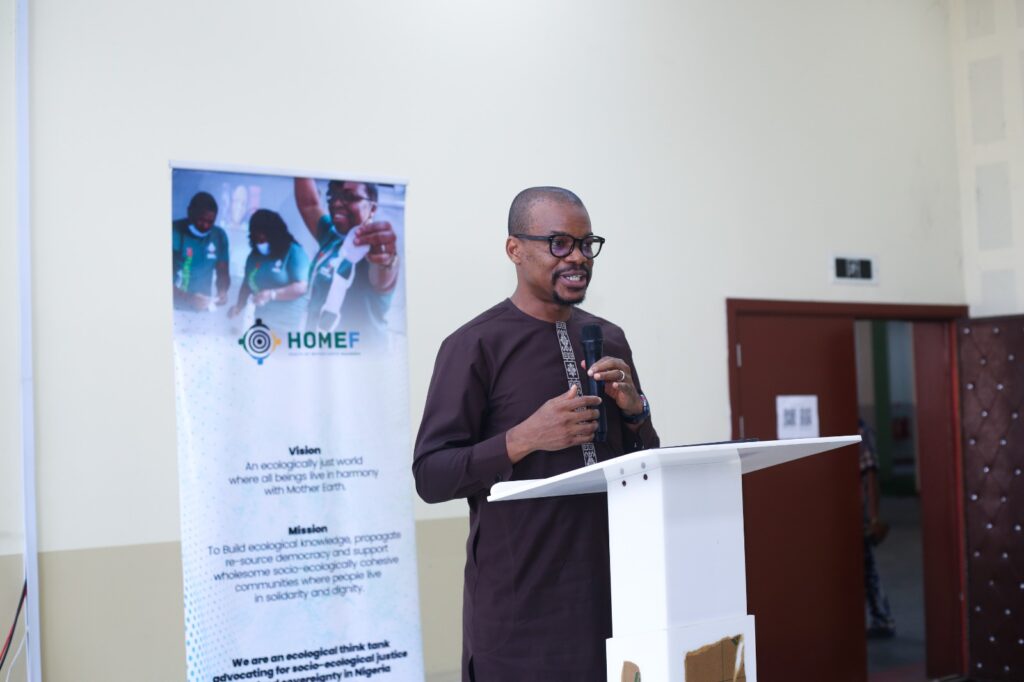
In his keynote remarks, Nnimmo Bassey, Executive Director of HOMEF, described food as far more than sustenance, emphasizing its cultural, social, and spiritual significance.
“Food unites people and families and marks acceptance in a home or community,” he said, noting that across Nigeria, diverse cuisines reflect the country’s rich cultural identity. From local delicacies such as amala and afang soup to globally adopted meals, food, he argued, tells the story of a people.
However, Bassey warned that this cultural anchor is under threat from shifting consumption patterns driven by globalization, urban lifestyles, and aggressive commercial interests.
Rise of Junk Food Culture
A major concern raised at the event was the growing dominance of fast foods, which Bassey described as fueling a “junk culture” built on convenience and instant gratification.
According to him, fast food environments are deliberately designed to overstimulate consumers through bright lighting, loud music, and constant visual distractions, discouraging reflection on what is being consumed.
He cautioned that beyond their appeal, such foods often carry hidden health risks, including exposure to excessive additives and harmful substances.
The situation, he added, is worsened when influential public figures normalize unhealthy consumption habits.
“When top politicians publicly indulge in sugary drinks and junk meals, it sends a dangerous message that such lifestyles are acceptable,” he said.
GMOs and “Food Colonialism”
Bassey also raised alarm over the increasing presence of genetically modified foods in Nigeria, warning of long-term implications for public health, local agriculture, and cultural identity.
He argued that policies restricting traditional seed sharing threaten communal farming systems and could entrench corporate control over agriculture.
Describing the trend as a form of “food colonialism,” Bassey linked it to broader geopolitical forces that shape global food systems through trade, debt, and cultural influence.
“Any law that prevents farmers from saving and sharing seeds disrupts community solidarity and replaces it with systems driven by profit and exploitation,” he stated.

Hunger as a Political Outcome
Providing a policy perspective, Amara Nwankpa of the Shehu Musa Yar’Adua Foundation challenged the widely held belief that hunger is primarily caused by insufficient food production.
Instead, he argued that hunger reflects deeper structural inequalities.
“Hunger is not a story about lack of food. It is about who food is for,” he said.
Citing data from Nigeria, Nwankpa noted that up to 40 percent of food produced in the country is lost before reaching consumers, undermining claims that low production is the main problem.
He further highlighted that between 50 and 75 percent of farming households in key agricultural regions remain food insecure, suggesting that those who produce food are often the most vulnerable.
Evidence Against Conventional Narratives
Nwankpa outlined several findings that contradict dominant narratives about food insecurity:
- Nigeria produces substantial food, but inefficiencies and waste prevent equitable distribution.
- Hunger is prevalent even within farming communities, pointing to systemic access issues.
- Productivity gaps are linked more to lack of credit, extension services, and market access than to technology deficits.
- The number of undernourished Nigerians has nearly doubled over the past decade, indicating a persistent structural problem.
Drawing from historical parallels, he referenced the Great Irish Famine, where food exports continued despite widespread starvation, illustrating how hunger can coexist with abundance.
Control of Food Systems
The forum also examined how power dynamics shape the global food value chain, from seed ownership to land use and trade policies.
Participants noted that control over seeds determines what farmers can grow, while land ownership patterns dictate who produces food and who must rely on markets.
Trade regimes and international pricing structures, they argued, often favour large-scale exporters at the expense of smallholder farmers.
“The food value chain is not neutral infrastructure,” Nwankpa stressed. “It is a system of power.”
The Seed Debate
A recurring theme was the symbolic and practical importance of seeds. Traditional seed systems, described as a “living archive” of knowledge and culture, are increasingly being replaced by commercialized, patented varieties.
Experts warned that this shift reduces farmers’ autonomy, limiting their ability to replant, share, and adapt seeds across seasons.
“The seed is not just an input. It is a covenant across generations,” Nwankpa noted.
Governance and Justice
Speakers agreed that food insecurity should be understood as a governance failure rather than a purely technical challenge.
They criticized current systems for protecting market concentration, shifting risks onto vulnerable populations, and excluding communities from decision-making processes.
To address this, the forum called for a socio-ecological transformation of food systems—one that redistributes power, ensures accountability, and centres community voices.
Call for Food Sovereignty
Both Bassey and Nwankpa emphasized the need for “food sovereignty,” where communities have the authority to define their own agricultural and food systems.
This, they argued, includes preserving indigenous food varieties, promoting local farming knowledge, and resisting external pressures that undermine local control.
Bassey urged Nigerians to “decolonize their food systems” by reclaiming traditional diets and protecting indigenous seeds.
The Bigger Question
As discussions drew to a close, a central question lingered: Who decides what people eat, and who bears the cost of those decisions?
For participants, the answer lies not just in policy reforms, but in a broader societal shift that recognizes food as a matter of justice, culture, and power—not merely production.
The session concluded with a call for deliberate action to rebuild Nigeria’s food systems in a way that promotes fairness, resilience, and sustainability.