Emamuzo Iboma
At the 2025 May Day symposium held in Lagos, members of Organised labour called on the government to urgently address the country’s widening economic disparity. They expressed concern that current monetary and economic policies have deepened the divide between the rich and the poor, leaving millions of Nigerians more impoverished and struggling to survive.
The chairman of the Trade Union Congress (TUC), Lagos Council, Gbenga Ekundayo, noted that while the effects of recent economic reforms are felt across all income levels, the impact is far more devastating for the poor, who lack the capacity to absorb the shocks.
“The challenges brought on by these reforms are significant—even for the wealthy. However, it’s easier for the rich to manage these shocks. The government must find a way to close the gap between the poor and the rich,” Ekundayo stated.
He added that despite the Central Bank of Nigeria’s (CBN) efforts to curb inflation by reducing financial liquidity, the situation continues to deteriorate for the economically vulnerable, with wealth remaining concentrated in the hands of a few.
Also speaking at the event, former National Deputy President of TUC, Oyinkansola Olasanoye, argued that simply increasing salaries will not solve the problem. She emphasized that the rapidly rising cost of living has outpaced wage adjustments.
“Higher salaries alone won’t improve living standards during hyperinflation. What truly matters is the purchasing power of the Naira. Instead of focusing solely on wages, the government should prioritize basic infrastructure like housing, healthcare, and transportation,” she advised.
Funmi Sessi, chairperson of the Nigeria Labour Congress (NLC), Lagos Council, echoed similar concerns. She said the current economic climate has become extremely harsh for workers, with hunger spreading and insecurity worsening.
“The purchasing power of workers has been significantly eroded. Many Nigerians don’t know where their next meal will come from. Though the government has made some efforts, people are suffering, and public discontent is rising. The administration must urgently review its economic policies to ease the burden on the masses,” she urged.
Speaking on the theme of this year’s symposium, ‘Reclaiming the Civic Space Amid Economic Hardship,’ Secretary of TUC Lagos Council, Abiodun Aladetan, said the theme reflects the realities faced by Nigerian workers.
“After the approval of the new minimum wage, expectations were high. Sadly, things have only gotten worse. These are some of the issues we need to critically examine,” he said.
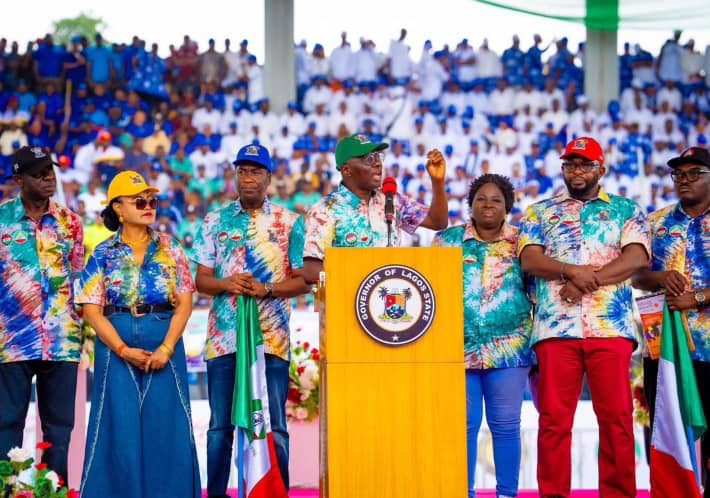
Governor Babajide Sanwo-Olu, in his address, maintained that his administration has kept its promises to Lagos workers. However, union leaders insist that the government must take further steps to address the growing poverty and hardship being endured by the average Nigerian.