PIA Advocacy for Implementation of 3% and Women Inclusion to Leadership
By Katherine Abayomi
The Petroleum Industry Act (PIA), from its inception as a Bill in the National Assembly to its current implementation stage, has faced numerous contentions as well as the 3% allocation to Host communities.
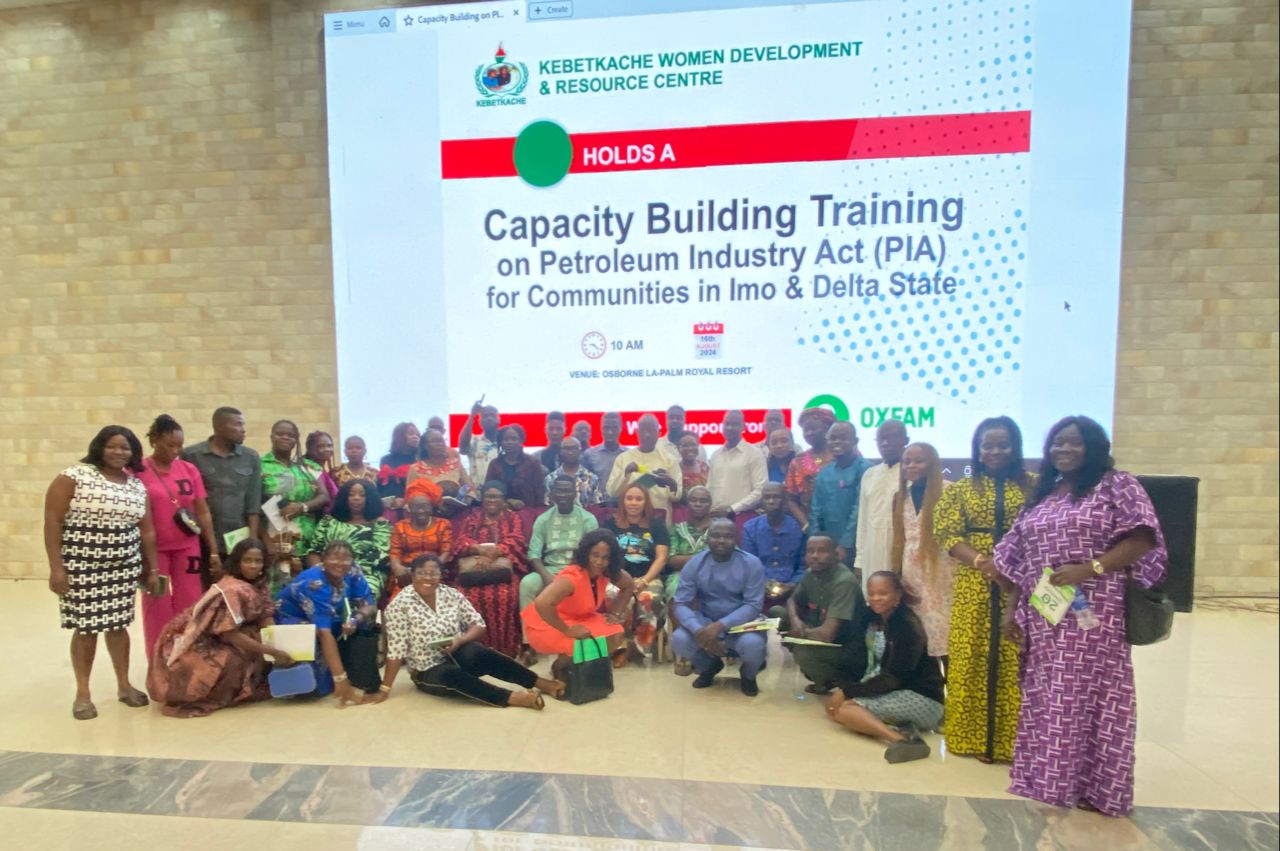
The Kebetkache Foundation, in collaboration with Oxfam, Organized a one-day capacity training workshop for Civil Society Organizations (CSOs) and community heads from Imo and Delta states. One of the focus of the event is on framing advocacy around the host communities as it pertains to the PIA.
Dr. Tubodenyefa Zibima, a lecturer and the Deputy Director of the Institute of Niger Delta Studies (INDS), emphasized that many community members are unaware of the established components due to the highly politicized nature of their composition.
“We can see that every community has its own specific experience regarding how these components have been established,” Dr. Zibima stated. “Many people do not even know these components exist in their communities, which speaks to the highly politicized nature of the process. The level of politics involved is driven by the significant funds attached to the operation of these mechanisms.”
Dr. Zibima pointed out that the current provisions of the PIA complicate efforts to ensure transparency and accountability due to external interference in the selection process of committee members.
“Regarding the implementation of the host community component of the PIA, the issue of accountability and transparency is crucial,” Dr. Zibima explained. “These are everyday terms, but in the context of the Niger Delta, they take on significant importance. The PIA’s provisions complicate efforts to achieve transparency and accountability. The selection process for the board of trustees, the management committee, and the advisory committee is subject to external interference, excluding community participation.
“Communities often have no idea how these individuals were selected, and even when they do, there is no community input. The bill states that committee members must be from the community, but the transparency of the selection process is marred by secrecy, making it difficult for these committees to operate transparently.”
“Also they can contribute extensive to the selection to the framing of their needs ,through their needs assessment if they do that ,if the area of intervention overtly determined communities, they decide what they want as a community based on their objective problems everyday economic, social problems and environmental problems it becomes difficult for these board or the Management committee do something outside what these communities want.”
Chilos Godsent, the Executive director of the Centre for Leadership and Development (CLD), spoke during an interview with our correspondent about the 3% not being implemented since it was signed into a bill and the formation of their trust fund has been inactive.
“Many Communities has not implemented the 3% since it was signed into bill,many communities have not formed their host committee trust fund.”
“You already know the set laws which are the companies determines predominately members of the committee, so it has been very difficult for many committees to the host community establish a board of trustees and trust fund because the board of trustees members can also come from another side the community so there are a whole lot of challenges/ lacuna within the PIA.”
Executive Director CID,Godsent, further stated the measures that can be put in place to curb the excesses and have result-oriented advocacy.
” We have noticed in the past that many of the community people have refused to understand that the IOCs are profit-making ventures and have limitations. So we think that the community people need to be more Organized because right now, there are three indices: Consciousness, Organisation, and action. “
We are conscious about the challenge s problems and impact of the issue of petroleum exploration in our various communities, but what is remaining is that we need to be more organized to engage in more coordinated advocacy and actions that will bring positive impacts to the implementations of many of the sections in the PIA”
He retorted that in spite that the offices of this trustee and board has been politicalized, community has to change it institutional framework and organisational framework ,and community must be intact and be respected.
A stakeholder from Mgbala Agwa in Oguta Local government area in Imo state talked about women inclusion to this bill,that women should be placed in line with their mates in every area of leadership .
The workshop encouraged communities to demand transparency and accountability in the selection and operation of these committees.