By Emamuzo Iboma
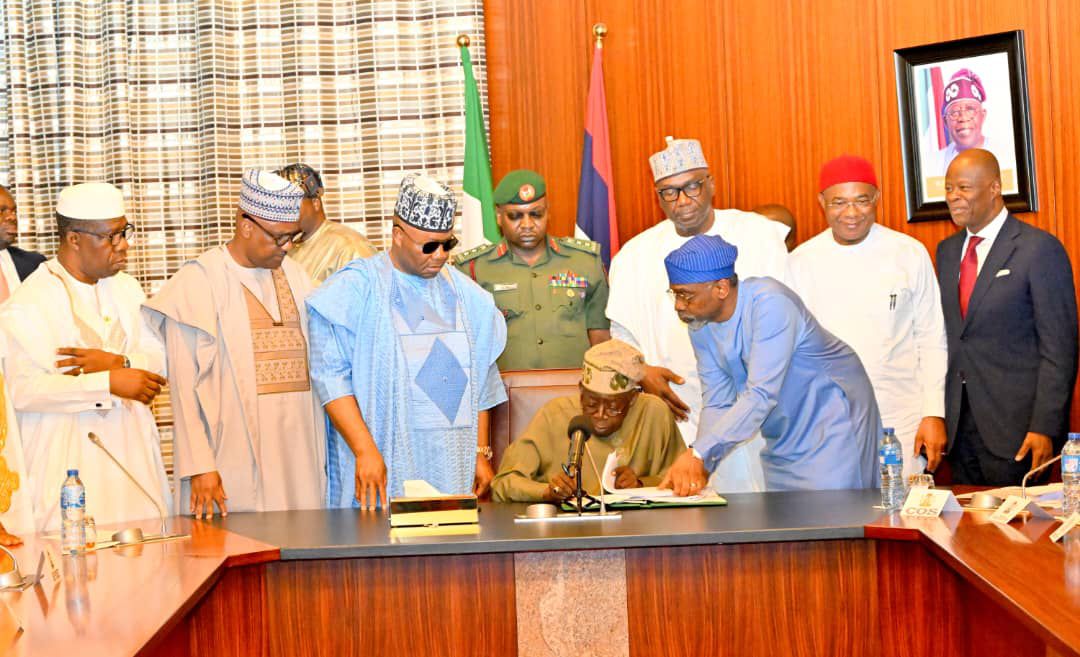
President Bola Tinubu has signed into law four significant tax reform bills, marking a major step in the transformation of Nigeria’s fiscal and revenue systems.
A statement from the Special Adviser on Information and Strategy, Bayo Onanuga, confirmed that the bills—namely the Nigeria Tax Bill, Nigeria Tax Administration Bill, Nigeria Revenue Service (Establishment) Bill, and Joint Revenue Board (Establishment) Bill—had earlier been approved by the National Assembly after extensive stakeholder consultations.
These legislative instruments are aimed at streamlining tax administration, boosting revenue collection, improving the business environment, and attracting both domestic and foreign investments.
The signing ceremony, which took place at the Presidential Villa in Abuja, was witnessed by key government officials including the Senate President, the Speaker of the House of Representatives, chairpersons of the Finance Committees, the Minister of Finance, and the Attorney General of the Federation.
The Nigeria Tax Bill is intended to harmonize the country’s numerous tax laws into a single statute, thereby reducing the number of taxes and easing compliance burdens. It is expected to create a more predictable and investor-friendly fiscal framework.
The Nigeria Tax Administration Bill establishes a unified framework for tax administration across all levels of government to improve efficiency and consistency in tax practices nationwide.
The Nigeria Revenue Service Bill replaces the existing Federal Inland Revenue Service Act and creates a more autonomous and performance-driven agency with expanded responsibilities, including oversight of non-tax revenues, and mandates greater transparency and accountability.
The Joint Revenue Board Bill formalizes cooperation among federal, state, and local revenue authorities. It introduces new oversight mechanisms, including a Tax Appeal Tribunal and an Office of the Tax Ombudsman, to ensure fairness and efficiency in tax administration.
Finance Minister Wale Edun described the signing of the bills as a critical milestone in President Tinubu’s reform agenda. He stated that the new laws would significantly improve the efficiency and equity of Nigeria’s tax system and were projected to nearly double the country’s tax-to-GDP ratio, which remains among the lowest in the world.