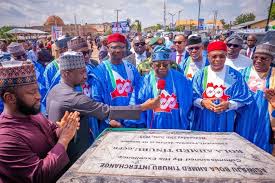
President Bola Ahmed Tinubu has officially commissioned indigenous electric vehicles, tricycles, and motorcycles in Nasarawa State, marking a significant milestone in Nigeria’s transition to sustainable transportation.
The event also featured the launch of several legacy infrastructure projects, highlighting the commitment of Governor Abdullahi Sule’s administration to innovation and environmental sustainability.
The commissioning signifies the formal establishment and operation of electric vehicle technology in the state, an initiative aligned with President Tinubu’s national policy on sustainable transportation. Governor Sule announced plans to empower residents across Nasarawa with electric vehicles to address transportation challenges and reduce dependence on fossil fuels.
Speaking at the event, the Chief Executive Officer of the Electric Motor Vehicle Company (EMVC), Prince Mustapha Audu, expressed gratitude to President Tinubu and Governor Sule for supporting local innovation and advancing the future of transportation.
Audu described EMVC as one of Nigeria’s leading electric vehicle manufacturers with operations in other states. He praised Governor Sule for pioneering mobility solutions in Nasarawa, noting the global shift towards electric vehicles as many countries prepare to phase out compressed natural gas (CNG) vehicles by 2030.
He said the company offers SUVs with a range of up to 1,200 km per charge and sedans with a 400 km range suitable for ride-hailing services. Additionally, the company produces locally made tricycles and motorcycles, popularly known as Igwe, designed to be affordable and durable on Nigerian roads.
Audu explained that the vehicles will be supported by solar-powered charging stations capable of powering three vehicles simultaneously without relying on the national grid or generators. Plans are in place to expand the number of charging stations to five in the near future.
He noted that vehicle owners can fully charge their cars with as little as ₦5,000, depending on battery capacity. The electric vehicles are powered by lithium batteries aimed at reducing carbon emissions and promoting clean energy usage.
To support long-term adoption, EMVC is setting up battery assembly lines, electric vehicle repair centers, and training hubs across the state. Each vehicle comes with a minimum two-year warranty. Audu pointed out that electric vehicles have fewer than 300 parts compared to over 25,000 in traditional vehicles, significantly reducing maintenance costs and complexity.
He said most issues would be electrical and that EMVC already has trained technicians on the ground, with plans to train more as demand increases.
While acknowledging challenges such as road conditions and climate, Audu assured that the vehicles were designed with Nigerian realities in mind. He expressed confidence in the durability of the locally manufactured electric vehicles, tricycles, and motorcycles and encouraged Nigerians to embrace the cleaner, more affordable alternative to transportation.