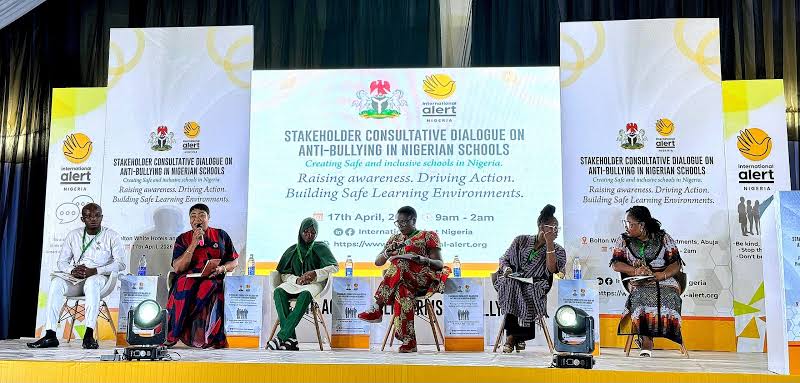
Stakeholders from government agencies, civil society, security institutions, and the education sector have called for urgent early intervention, stronger enforcement of anti-bullying policies, and expanded youth empowerment programmes to address rising cases of bullying in Nigerian schools.
They made the call at a Stakeholder Consultative Dialogue on Anti-Bullying in Nigerian Schools convened by International Alert Nigeria on Friday in Abuja, where experts warned that bullying is increasingly becoming a major driver of mental health challenges and broader social risks among young people.
NDLEA links bullying to drug abuse risks
Chairman of the National Drug Law Enforcement Agency (NDLEA), Brig.-Gen. Mohammed Marwa, warned that persistent bullying could expose young people to substance abuse and other harmful coping behaviours.
Represented by Henrietta HoldGod of the agency’s Counselling and Psychosocial Support Unit, he said victims of bullying often suffer anxiety, depression, low self-esteem, and social withdrawal.
He stressed that in some cases, affected students may resort to drugs as a coping mechanism, noting that prevention of bullying directly aligns with NDLEA’s broader preventive mandate.
“Protecting children from bullying also means protecting them from pathways that may lead to drug abuse and other harmful behaviours,” he said, adding that safer schools are essential for building resilient communities.
NAPTIP urges zero tolerance and collective responsibility
The Director-General of the National Agency for the Prohibition of Trafficking in Persons (NAPTIP), Binta Bello, described bullying as a violation of human rights that requires collective action across homes, schools, and communities.
Represented by NAPTIP Director Rebecca Enwusoyere, she called for strict zero-tolerance policies in schools, stronger parental engagement, and sustained community advocacy.
She also urged stakeholders to equip young people with skills to identify, resist, and report bullying, stressing that awareness campaigns, peer education, and safe reporting channels are critical to preventing silent suffering among victims.
Experts warn of rising mental health burden
A Senior Research Fellow in International Education and Development at the Open University, Dr. Margaret Ebubedike, said bullying had worsened in the post-COVID-19 period, with significant consequences for students’ mental health and learning outcomes.
She noted that bullying extends beyond individuals to affect families and the education system, disrupting academic engagement and undermining safe learning environments.
Citing regional data, she said between 27 and 50 percent of children in Sub-Saharan Africa experience bullying, warning that Nigeria’s situation appears more severe, with more than half of secondary school students reportedly affected.
“Tackling bullying requires a collective response involving parents, educators, policymakers, and communities,” she said.
Security agency warns of wider societal risks
The Commandant-General of the Nigerian Security and Civil Defence Corps (NSCDC), Dr. Ahmed Audi, cautioned that unresolved bullying cases could escalate into broader security threats if not addressed early.
Represented by CSC Adeoye Adegoke, he emphasised the need for early reporting systems and coordinated institutional responses to prevent escalation.
Federal Government reiterates policy commitment
The Federal Government reaffirmed its commitment to tackling bullying through the National Policy on Anti-Bullying in Schools.
Representing the Federal Ministry of Youth Development, Mrs. Augustine Udo said the policy provides a framework for accountability, protection, and enforcement, urging stakeholders to move from policy discussions to practical implementation.
She called for stronger reporting mechanisms and increased empathy among students, teachers, and parents.
The Federal Ministry of Education Nigeria also confirmed that implementation guidelines and a dedicated committee have been established to ensure nationwide rollout of anti-bullying measures across schools.
Experts push for system-wide action
Behavioural Change Communication expert, Ms. Ayotola Ilori, said data shows bullying is widespread, with about 32 percent of Nigerians aged 12 to 17 affected, while as many as 85 percent are either victims, perpetrators, or both.
She welcomed the 2025 National Anti-Bullying Policy but warned that policy design alone is insufficient without full system-level implementation across schools nationwide.
Ilori also called for coordinated action across all 774 local government areas, urging students to speak up and avoid silence when facing bullying.
International Alert calls for practical interventions
Country Director of International Alert Nigeria, Dr. Kingsley Udo, said the initiative was prompted by growing concerns over recent bullying incidents, including a widely reported case in Edo State.
Represented by Programme Manager Sunday Jimoh, he said the dialogue aimed to move beyond awareness creation to actionable policy solutions.
He noted that bullying is not limited to schools but also exists in workplaces, sports, and leadership spaces, describing it as a broader societal challenge.
Udo said the organisation is working with schools to establish Youth Peace Clubs, where students are trained in conflict resolution and the psychological impact of bullying.
He added that safe reporting systems are also being developed to ensure victims can report incidents before they escalate.
At the end of the dialogue, organisers said a communiqué and policy roadmap would be developed to guide future advocacy and strengthen government engagement on anti-bullying interventions nationwide.